The Horses of Soulful Equine
Feeding horses commercially prepared feeds is popular in the equine industry because it’s a convenience.
You believe you’re doing what’s best for your equine companion. However, have you considered that possibly the contents of that nicely packaged equine product could be harmful?
The intent of this article is not to bash particular name brands or give you complete solutions but rather to provide information to promote awareness about feeding horses commercially prepared food.
If you haven’t been concerned about how many horse feed recalls there have been in the last decade, it may be time to think about it and choose your horse products wisely. By wisely, I mean not just from a nutritional standpoint but also from a safety standpoint.
You may be interested in an article that was published in the Horse Journal called Feed Recall. This is just one of many articles over the years informing us to be careful. Those conveniently, well-packaged and well-marketed horse feeds may not be what is best for your equine partner.
Another informative article is from the June 2009 Horse Journal titled Grain Quality And Your Horse’s Feed. For those who haven’t read it, once you do, you may think twice before making that trip to the feed store.
My Intent is to Get You to …
- Think more about what you feed your horse
- Question all brands; don’t trust/assume a name brand is safe for your horse
- Use a Back To Basics approach
Let’s face it, it doesn’t matter what the subject is, there will be differing opinions – especially when it comes to feeding our equine companions. I’ve noticed over the years that people who are considered authorities on certain subjects in the horse industry don’t agree with each other.
There are also times I feel that some experts get so bogged down in the research they forget to bring Mother Nature and intuition into the equation, however, the logical mind wants “proof.” What’s even more interesting is that most studies contradict each other or come to no logical conclusion … so who do you believe?
Well, I’m not going to tell you who to believe. However, I’ll share with you my own experiences and what I’ve learned from horses in my care.
Since I’ve been a nutrition fanatic for most of my adult life, it has come in handy when trying to understand what my horses need in their diets.
Before I go much further, you’re probably wondering, “Does she think every commercial equine feed is bad?” The answer is no, but I have yet to find one I’d feel comfortable feeding or recommending. There are some organic feeds on the market that may be good, but I’ve only looked at a few and based on the ingredients, still decided not to buy them.
Are You Looking for a Magic Bullet or Quick Fix?
Over the years I’ve noticed commercial feeds for horses almost mirroring the “fad” diets that have come along in humans (i.e. low fat diets, low carb diets, etc.). Now, due to the epidemic of insulin resistance (IR) in horses, the latest trend is the mass manufacturing of low carbohydrate feeds and supplements.
These companies claim their products control IR in horses but it’s mostly brilliant marketing and high prices. I personally don’t believe the hype. In my humble opinion, there is no magic bullet that works as a complete whole-istic approach!
A Few Tips
The complexity on the subject of nutrition is out of the scope of a simple article. What I can offer you is this short list of what to consider:
- Avoid pelleted anything … yes, I know, pellets are popular, but do you really know what’s going into that pellet?
- In order to create a pellet, high heat must be used, which will destroy food enzymes that help horses digest their food.
- Commercially prepared feeds will mold or spoil more quickly than a natural whole food grain.
- Most vitamins aren’t stable in commercial mixes for long.
- Chelated minerals that are used in most products may be a waste of money.
- You may say, “but I have an older horse who must have pellets.” Not true, there are ways around this if you’re willing.
- It’s difficult to determine the quality of grains that have been processed or heated. With whole grains, you can check the color, size, and cleanliness easily.
- Do you remember all the pet food recalls? What about all the horse feed recalls in the last ten years?
Hopefully, you’ll give the subject of providing your horse commercially prepared feed some thought.
Lets talk briefly about the Back to Basics I mentioned in my opening paragraphs.
Back To Basics
In short, a naturally fed horse means you provide your equine partner whole grains (if needed), plenty of forage, and quality salt and minerals instead of heavily processed commercial feeds. Think whole food form instead of processed. I liken it to choosing an apple over a Twinkie or donut. Which choice is more likely to provide you the nutrition your body needs for longevity and quality of life?
The less a food or supplement is processed and the fewer ingredients it contains, usually it’s the better choice. Remember … minimal or no processing is ideal!”
I believe that horse nutrition for the domesticated horse is an art and a science. If we stick to what horses would seek out on their own in the wild – I’ll give you a hint, it’s not a commercially prepared pellet – then our equine companions can maintain a much higher level of health.
Keep it soulful,
Stephanie Krahl
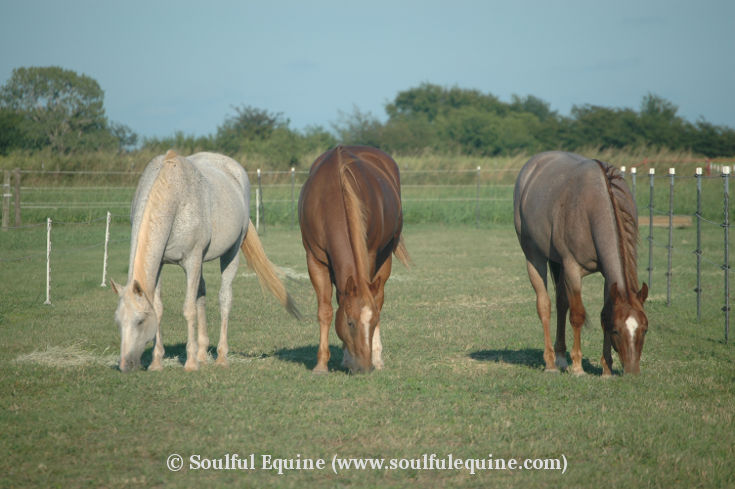
About The Image
Credit: Lynn, my wonderful sister – professional photographer.
The picture is of Soulful Equine’s horses, from left to right:
- Faith – 24 YO Appendix QH Mare
- Dillon – 21 YO QH Gelding : IR challenged
- Ransom – 3 YO QH Gelding
For more details, see our Soulful Equine About Page.